
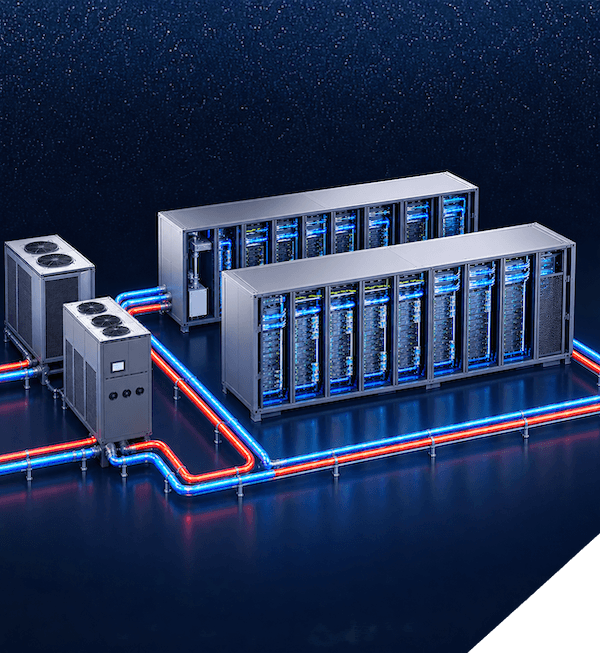
Quick answer: Single-phase direct-to-chip cooling keeps coolant liquid as it absorbs heat. Two-phase cooling uses controlled evaporation and condensation to transfer heat. Choose between them using the server’s validated requirements, thermal performance and operating model. Chip power alone does not establish a universal point at which a facility must switch from one approach to the other.

Liquid cooling is an established design choice for high-density computing. The practical question is which cooling circuit fits the selected hardware and the facility that will support it. Comparing single-phase and two-phase systems requires more than looking at the largest heat-load figure in a product brochure.
Understand what changes phase
In a single-phase system, coolant passes through cold plates attached to heat-generating components and returns warmer. Heat is transferred out of that circuit through the selected cooling infrastructure, allowing the coolant to circulate again. Water-based and glycol-based fluids are common options, subject to the equipment specification.
In a two-phase system, some coolant evaporates while absorbing heat and later condenses, releasing that heat elsewhere in the circuit. The working fluid and operating pressure influence the boiling conditions. ZutaCore’s technical explanation describes this mechanism for its direct-to-chip system; its product-specific claims should be evaluated against the proposed configuration. Two-phase cooling explained
Both approaches can use cold plates at the processor. Neither should be confused with immersion cooling, where electronic assemblies are placed in a fluid bath. Identify the actual architecture before comparing installation or service requirements.
Start with the server configuration
Ask the server supplier which cooling systems and fluids it supports for the exact equipment being purchased. Record the allowed temperatures, flow or circulation requirements, pressure limits and connection specifications. The approved configuration is a stronger starting point than a general statement about a cooling technology.
Higher processor power makes thermal design more demanding, but heat flux, cold-plate geometry and allowable component temperature also matter. A chip’s thermal design power does not independently determine the correct phase-change strategy. Compare validated performance at the required operating conditions.
Request evidence covering the intended workload and control behavior, not only a steady-state maximum. Identify any restrictions on startup, partial loading, equipment changes or operation outside the normal envelope. Record who approves the complete combination of server, cold plate and cooling circuit.
Compare the operating requirements
|
Consideration |
Single-phase direct-to-chip |
Two-phase direct-to-chip |
|
Heat transfer |
Coolant warms while remaining liquid |
Coolant evaporates and later condenses |
|
Key design inputs |
Temperature, flow, pressure and fluid properties |
Fluid, pressure, boiling and condensation conditions |
|
Hardware approval |
Validate server, cold plate and coolant combination |
Validate server, evaporator and working-fluid combination |
|
Operations |
Plan fluid quality checks and loop maintenance |
Plan fluid management and phase-control servicing |
|
Facility interface |
Confirm heat exchanger and heat-rejection requirements |
Confirm condenser and heat-rejection requirements |

Evaluate 45°C operation at the correct interface
Warm-water cooling can be attractive when the IT hardware supports it. EPG’s Cooling Solution describes secondary inlet temperatures around 45°C in suitable configurations. That is a design option to validate, rather than a temperature to apply to every server or cooling technology.
Specify whether a quoted value refers to facility water, the technical cooling loop or the server inlet. A heat exchanger needs a temperature difference to transfer heat, so temperatures at these locations are not interchangeable. For two-phase equipment, also establish which temperature and pressure describe the working-fluid circuit.
Ask each supplier to explain the consequences for the external heat-rejection system across the site’s weather conditions. A higher supported coolant temperature may broaden the available options, but the complete design determines whether supplemental cooling is required.
Review serviceability before comparing cost
Single-phase maintenance planning should address fluid condition, filtration where specified, connection integrity and safe component isolation. Two-phase planning should address the selected fluid’s handling requirements and the equipment needed to service its circuit. Procedures should come from the system supplier rather than be transferred from another technology.
For either approach, ask how technicians identify a problem, isolate the affected equipment and restore service. Review training, spare parts, fluid availability and the warranty boundaries between the cooling and server suppliers. Include practical access to the equipment in the comparison.
The Open Compute Project publishes cold-plate resources covering interfaces, coolants and the wider technology cooling system. These can help structure a specification review, while the selected manufacturers remain responsible for approving their equipment combination. OCP cold-plate resources
Compare proposals with the same test conditions
Give bidders a common brief: rack configuration, thermal load, site conditions, maintenance requirements and expansion plan. Ask for performance evidence under those conditions and a list of assumptions that still need confirmation. Separate demonstrated capability from future product plans.
Consider a project where the initial racks are already approved for single-phase cooling. A proposed move to two-phase should identify the benefit, required hardware changes and effect on support arrangements. Conversely, a validated two-phase platform should be assessed on its own requirements rather than forced into an existing water-loop specification.
Evaluate energy and operating cost across the full heat-removal path. Include circulation equipment, heat rejection, maintenance and any remaining air-cooling load. A component-level advantage is useful only if it improves the project’s overall outcome.
Choose a supported system, not a headline rating
The stronger choice is the one that meets the thermal requirement with clear compatibility, maintainable equipment and a credible support plan. Agree factory and site acceptance criteria before committing to the selected system.
Explore EPG’s AIDC Solution and Cooling Solution to coordinate rack requirements with facility cooling and modular deployment. Begin with the approved hardware specification, then evaluate the cooling architecture against the site and operational brief.