
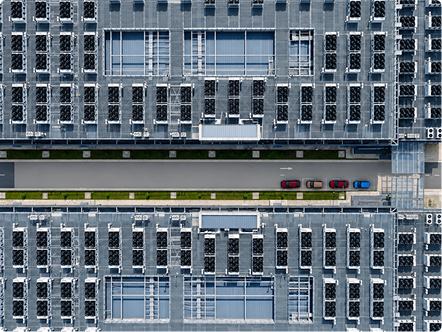
Quick answer: IDC architecture is the design of an Internet Data Center — a facility that houses servers, storage, and networking to deliver internet and cloud services. The architecture spans the physical layout, power and cooling systems, network topology, and redundancy that together determine the facility’s capacity, efficiency, and reliability.

Behind every website, app, and cloud service is a building most people never see: a data center. In much of the world — particularly across Asia — these facilities are known as Internet Data Centers, or IDCs. Understanding IDC architecture means understanding how such a facility is structured to keep digital services running reliably, efficiently, and at scale.
What is an Internet Data Center (IDC)?
An Internet Data Center is a facility built to house the computing infrastructure that delivers internet-based services. That includes the servers that process and store data, the storage systems that hold it, and the networking equipment that moves it to and from users. “IDC” and “data center” are often used interchangeably; the IDC term simply emphasises the facility’s role in delivering internet and cloud services, and it remains the common phrasing across many APAC markets.
What turns a room full of servers into a true IDC is the surrounding architecture — the deliberate design of power, cooling, networking, and physical space that keeps those servers available around the clock.
The core layers of IDC architecture
A useful way to understand data center architecture basics is to think in layers, each one supporting the one above it.
- Facility and physical layer. The building itself: the site, structure, security, raised floors or slab, and the physical layout of rooms and racks. It sets the constraints everything else works within — how much equipment can be housed and how much power and cooling can be delivered.
- Power layer. Utility power enters the facility and must be transformed, distributed, conditioned, and backed up. This layer includes switchgear, uninterruptible power supplies (UPS) for clean, continuous power, and backup generators that take over during a grid outage. Power is mission-critical — any interruption risks downtime.
- Cooling layer. Every watt of power delivered to IT equipment becomes heat that must be removed. The cooling layer — air handling, chilled water, and increasingly liquid cooling for higher densities — keeps equipment within safe operating temperatures.
- Network layer. The connectivity fabric: the switches, routers, and cabling that link servers to each other and to the outside world, along with the redundant internet connections that keep the facility reachable.
- IT and compute layer. At the top sit the servers, storage arrays, and the workloads they run. This is the layer that actually delivers value; everything below exists to keep it running.
Tiers and redundancy
Not all IDCs are built to the same standard of reliability. The industry uses a tier classification — Tier I through Tier IV — to describe how much redundancy a facility has and, therefore, how much downtime it can avoid. Higher tiers add duplicate power and cooling paths so that equipment can fail or be maintained without taking services offline. Choosing a tier is a balance between cost and the availability a business actually needs.
Redundancy is the mechanism behind those tiers, usually expressed as configurations like N+1 or 2N — shorthand for how much spare capacity is built in.
How IDC architecture is evolving for AI
Traditional IDC architecture was designed around racks drawing perhaps 5–15 kW, with air cooling and modest, steady workloads. Artificial intelligence is straining that model. AI racks can draw 40–100 kW or more, generating heat that conventional cooling can’t handle and demanding far more power per square metre.
As a result, IDC design is evolving: liquid cooling is moving from optional to essential, power architecture is being rethought for sustained heavy loads, and structural and density assumptions are being revisited. The gap between a traditional IDC and a purpose-built AI facility is now wide enough to be a category of its own — see our explainer on what makes an AI data center different.
IDC, colocation, and cloud: how the terms relate
Because the vocabulary overlaps, it helps to separate three related ideas. An IDC describes the type of facility — one built to deliver internet and cloud services. Colocation describes a business model, in which an operator rents space, power, and cooling inside a data center to customers who install their own equipment; a colocation facility is still an IDC architecturally. Cloud describes how computing is consumed — on-demand, as a service — and runs on top of physical data centers, whether owned by the cloud provider or leased. In short, IDC is the building, colocation is one way to sell its capacity, and cloud is a way to deliver services from it. The architecture underneath is the common foundation all three depend on.
Designing IDC architecture well
Good IDC architecture is ultimately about balancing four goals: capacity (enough power, space, and cooling for the workloads), efficiency (delivering that capacity without wasting energy or water), reliability (the right level of redundancy for the services it hosts), and scalability (room to grow in repeatable, prefabricated increments without rebuilding from scratch). Strong designs make these trade-offs deliberately rather than by accident, and they leave room to adapt as workloads — especially AI — continue to change.
The foundation everything runs on
IDC architecture is the blueprint that turns hardware into dependable digital services. Its layers — facility, power, cooling, network, and compute — work together to deliver capacity reliably and efficiently, while tiers and redundancy define how resilient the result is. As AI reshapes what data centers must handle, that architecture is being rethought from the ground up.
To go deeper, explore EPG’s IDC solution, or see how traditional IDC design compares with a purpose-built AI data center.